
RAG vs fine-tuning: choosing an approach for a business AI project
An internal assistant can fail because it cannot find the current policy, or because it does not follow the required response format. Those are different problems. Retrieval-augmented generation and fine-tuning address different parts of an AI system, and either approach still needs evaluation.
In this guide
Name the failure before choosing the technique
Consider a fictional service company building an assistant for installation instructions. One answer cites a superseded manual. Another contains the right information but ignores the company’s required checklist format. A third responds to a question the available documents cannot answer. Group those failures before discussing model changes.
The outdated manual points towards content selection and freshness. The formatting problem may be addressed through instructions, examples or model adaptation. The unsupported answer needs a defined uncertainty and handover policy. Buying a more elaborate architecture before separating these cases can make the underlying issue harder to see.
What retrieval adds to the answer
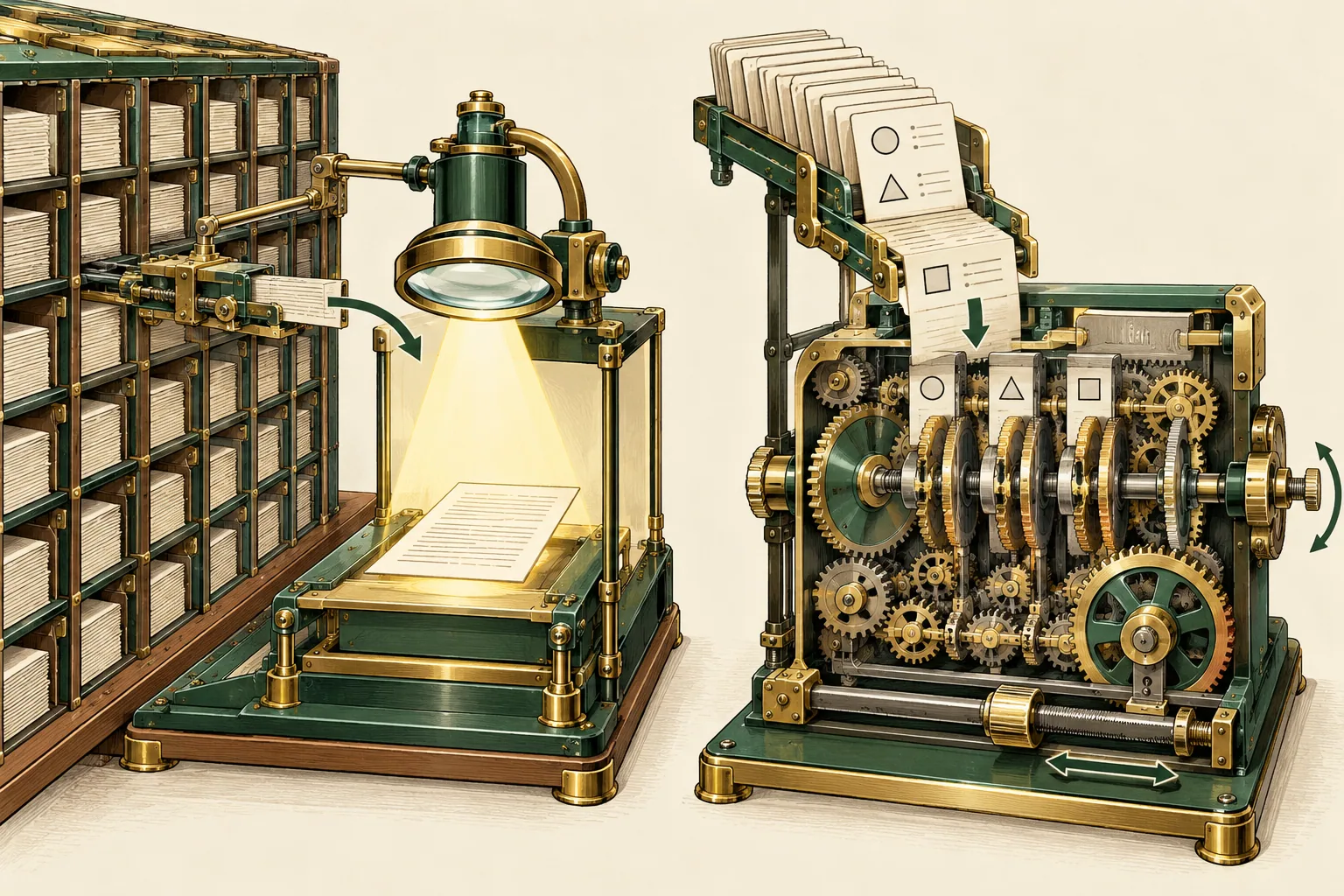
Retrieval-augmented generation, usually shortened to RAG, finds relevant material and supplies it as context for the answer. OpenAI’s file-search documentation, for example, describes semantic and keyword search over uploaded files. The retrieval layer is part of the application around the model.
For the installation assistant, the library could contain current manuals identified by product and revision. The system must select the right revision and respect the reader’s access. Uploading all historical PDFs into one undifferentiated collection does not solve either requirement. Plan the metadata and removal process alongside the initial import.
What fine-tuning changes
Supervised fine-tuning uses examples of desired input-output behaviour to adapt model weights. It is not simply another name for uploading the company handbook. OpenAI’s current documentation also carries an important availability warning: its fine-tuning platform is winding down and is closed to new users. As checked on 25 October 2026, eligible existing customers have a limited remaining training window, subject to model-specific shutdown dates.
Treat the general technique separately from a particular supplier’s availability. Before investing in data preparation, verify that the chosen service is available for your organisation and has a workable lifecycle. Do not select a retiring route merely because an older tutorial recommends it.
Compare the operating responsibilities
| Concern | Retrieval approach | Fine-tuning approach |
|---|---|---|
| Frequently changing facts | Maintain and refresh source material | Do not rely on training alone for live facts |
| Required answer style | Test instructions and examples first | Assess consistent training examples and evaluation |
| Source visibility | Design references and retrieval inspection | Do not assume an answer includes source evidence |
| Lifecycle | Maintain ingestion, search and permissions | Maintain dataset, model availability and regression checks |
The approaches can coexist, but that adds responsibilities. A model with adapted behaviour can still retrieve the wrong document. A well-maintained index can still feed a model that produces an unsuitable answer. Compare a simple working baseline before assuming both layers are necessary.
Build an evaluation set before the demonstration
For the fictional company, include a current installation question, a similar product name, an obsolete revision, a missing answer and a question restricted to another team. Write the expected evidence and acceptable response for each. Keep some cases outside the examples used to configure the system.
Record whether the right information was found, whether the answer used it correctly and whether the next step was appropriate. Those observations help locate the failure. A single overall score can conceal a serious access error or a consistently weak response to one product family. Inspect examples rather than relying solely on a headline average.
Budget for the information pipeline
Ask for separate estimates for document preparation, ingestion, retrieval, model calls and evaluation. Include the person who will remove obsolete material. If a manual is replaced, someone must verify that the replacement is searchable and that answers no longer depend on the old revision. That maintenance obligation remains even when the supplier hosts the search infrastructure.
Choose the smallest maintainable architecture
Start with a prompt and an approved small document set if that is enough to test the task. Introduce retrieval when the library, freshness or selection problem justifies it. Consider model adaptation only when a repeatable behaviour problem remains, suitable examples exist and the selected service has a viable operating path.
The business AI data-controls guide covers the upload and permission questions. The Pinecone and Weaviate profiles are starting points for retrieval infrastructure research. Budget for evaluation, source ownership and correction work as well as model or database usage.
Frequently asked questions
Is RAG the same as fine-tuning?
No. RAG retrieves information into the context used for an answer. Fine-tuning adapts model behaviour through a training process.
Does fine-tuning keep an assistant up to date?
Do not use it as a substitute for a current information source. Frequently changing facts need a maintained retrieval or other live-data path.
Should a new project start with OpenAI fine-tuning?
Check current availability first. On 25 October 2026 the documented OpenAI fine-tuning platform is winding down and closed to new users; other approaches and suppliers require their own assessment.
Put the guide into practice
Explore ai model & agent platforms tools, then compare your shortlist.
Explore the category →